IIT JEE Preparation – Complete Study Resources for Class 11 & 12
Preparing for IIT JEE requires strong concepts, regular practice, effective revision and consistent problem solving. GoCareerGo provides useful IIT JEE preparation resources for Class 11 and Class 12 students, including Physics, Chemistry and Mathematics study material, short notes, formula sheets, MCQs, important questions and preparation tips.
Whether you are starting your JEE preparation in Class 11, strengthening your concepts in Class 12, preparing for JEE Main or aiming for JEE Advanced, use this page to find the right study resources and practice material.
What is IIT JEE?
IIT JEE is one of the most competitive engineering entrance examination pathways in India. Students preparing for engineering admissions need a strong understanding of Physics, Chemistry and Mathematics along with regular practice and revision.
JEE preparation is not only about memorising formulas. It requires understanding concepts, learning how to apply them to different problems, analysing mistakes and improving speed and accuracy.
A good preparation strategy should therefore combine:
- Conceptual understanding
- Chapter-wise study
- Formula revision
- Regular MCQ practice
- Previous-year question practice
- Mock tests
- Mistake analysis
- Time management
- Consistent revision
IIT JEE Preparation for Class 11
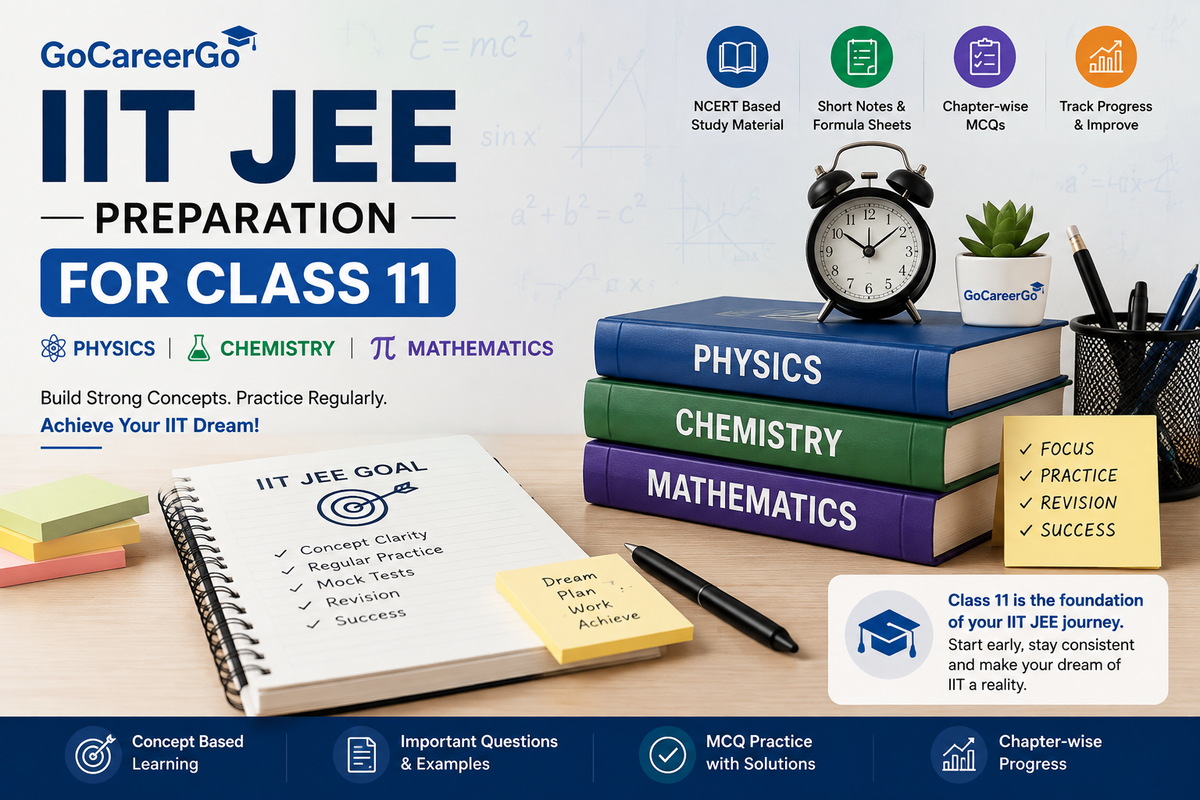
Class 11 is an important stage for building the foundation of JEE preparation. Many important concepts introduced in Class 11 are used again in advanced topics later.
Students should focus on understanding the basic concepts rather than rushing through the syllabus.
Class 11 Physics
Focus on understanding concepts, formulas and numerical problem solving.
Important areas include:
- Units and Measurements
- Vectors
- Motion in a Straight Line
- Motion in a Plane
- Laws of Motion
- Work, Energy and Power
- System of Particles
- Rotational Motion
- Gravitation
- Properties of Matter
- Thermodynamics
- Kinetic Theory
- Oscillations
- Waves
Class 11 Chemistry
Chemistry preparation should combine concepts, calculations, reactions and regular revision.
Important areas include:
- Some Basic Concepts of Chemistry
- Structure of Atom
- Classification of Elements
- Chemical Bonding
- Thermodynamics
- Equilibrium
- Redox Reactions
- Organic Chemistry Basics
- Hydrocarbons
- States of Matter
- Periodic Properties
Class 11 Mathematics
Mathematics requires regular problem solving and strong conceptual clarity.
Important areas include:
- Sets
- Relations and Functions
- Trigonometry
- Complex Numbers
- Quadratic Equations
- Sequences and Series
- Permutations and Combinations
- Binomial Theorem
- Coordinate Geometry
- Straight Lines
- Circles
- Limits
- Statistics
- Probability
IIT JEE Preparation for Class 12
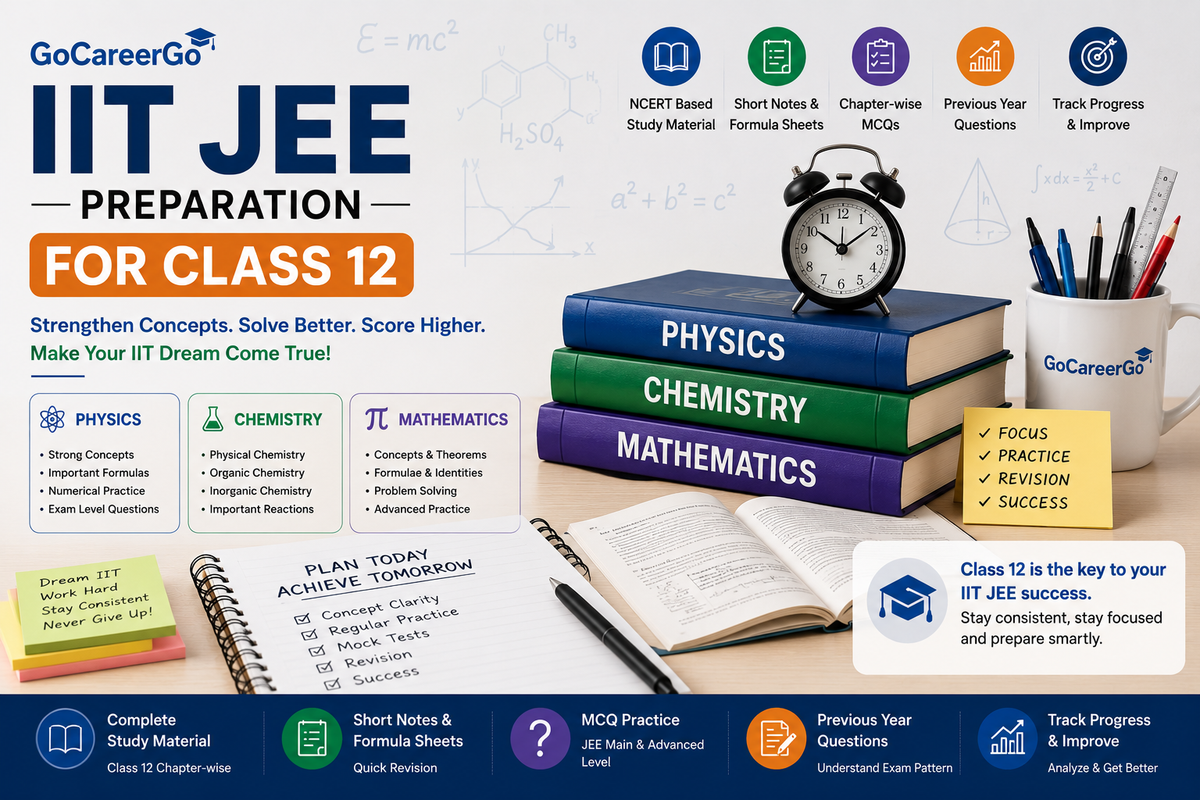
Class 12 preparation should focus on completing the syllabus while continuously revising Class 11 concepts.
Do not wait until the end of Class 12 to revise previous topics. Regular revision helps maintain concepts and reduces the pressure before examinations.
Class 12 Physics
Important areas include:
- Electrostatics
- Current Electricity
- Magnetic Effects of Current
- Magnetism
- Electromagnetic Induction
- Alternating Current
- Electromagnetic Waves
- Ray Optics
- Wave Optics
- Dual Nature of Matter
- Atoms
- Nuclei
- Semiconductor Electronics
Class 12 Chemistry
Important areas include:
- Solutions
- Electrochemistry
- Chemical Kinetics
- Coordination Compounds
- d- and f-Block Elements
- Haloalkanes and Haloarenes
- Alcohols, Phenols and Ethers
- Aldehydes, Ketones and Carboxylic Acids
- Amines
- Biomolecules
- Organic Chemistry
- Important Chemical Reactions
Class 12 Mathematics
Important areas include:
- Relations and Functions
- Inverse Trigonometric Functions
- Matrices
- Determinants
- Continuity and Differentiability
- Applications of Derivatives
- Integrals
- Applications of Integrals
- Differential Equations
- Vector Algebra
- Three-Dimensional Geometry
- Probability
Physics for IIT JEE
Physics becomes easier when you understand the concept behind a formula instead of simply memorising it.
While studying Physics, follow this approach:
Concept → Formula → Example → Questions → MCQs → Revision
Start each chapter by understanding the basic theory. Make a short formula sheet and then solve progressively difficult problems.
Physics Preparation Tips
- Understand the physical meaning of formulas.
- Draw diagrams whenever required.
- Keep a separate formula sheet.
- Solve numerical problems regularly.
- Review questions you answered incorrectly.
- Practise both conceptual and numerical questions.
- Revise important formulas regularly.
Chemistry for IIT JEE
Chemistry requires a balanced approach because different parts of the subject require different preparation methods.
Physical Chemistry
Focus on concepts, formulas and numerical practice.
Organic Chemistry
Focus on reaction mechanisms, concepts, named reactions and conversions.
Inorganic Chemistry
Focus on understanding trends, important reactions, properties and regular revision.
Chemistry Preparation Strategy
- Read concepts carefully.
- Create short revision notes.
- Maintain a formula sheet for Physical Chemistry.
- Create reaction charts for Organic Chemistry.
- Revise important Inorganic Chemistry topics frequently.
- Practise MCQs after completing each chapter.
Mathematics for IIT JEE
Mathematics improves primarily through problem solving.
Reading a solution is not the same as solving a problem yourself. Try to solve questions independently before checking the solution.
Mathematics Preparation Strategy
- Understand the concept.
- Learn the important formulas.
- Solve basic questions.
- Move to moderate questions.
- Practise JEE-level problems.
- Analyse mistakes.
- Revise the chapter regularly.
Keep a separate notebook for difficult questions and questions that you repeatedly get wrong.
JEE Short Notes
Short notes are extremely useful for quick revision.
Instead of reading an entire chapter again, use short notes to quickly revise important concepts, formulas, reactions, shortcuts and key points.
Your short notes can include:
- Important definitions
- Important formulas
- Important concepts
- Short tricks
- Important reactions
- Graphs
- Diagrams
- Common mistakes
- Frequently asked concepts
Short notes are particularly useful before tests and during revision.
JEE Formula Sheets
Formula revision should be a regular part of JEE preparation.
Create separate formula sheets for:
Physics Formulae
Keep important formulas chapter-wise and revise them regularly.
Chemistry Formulae
Maintain formulas for Physical Chemistry and important numerical concepts.
Mathematics Formulae
Keep important identities, equations, calculus formulas, coordinate geometry formulas and other frequently used results together.
Do not only memorise formulas. Learn where and when each formula should be applied.
IIT JEE MCQ Practice
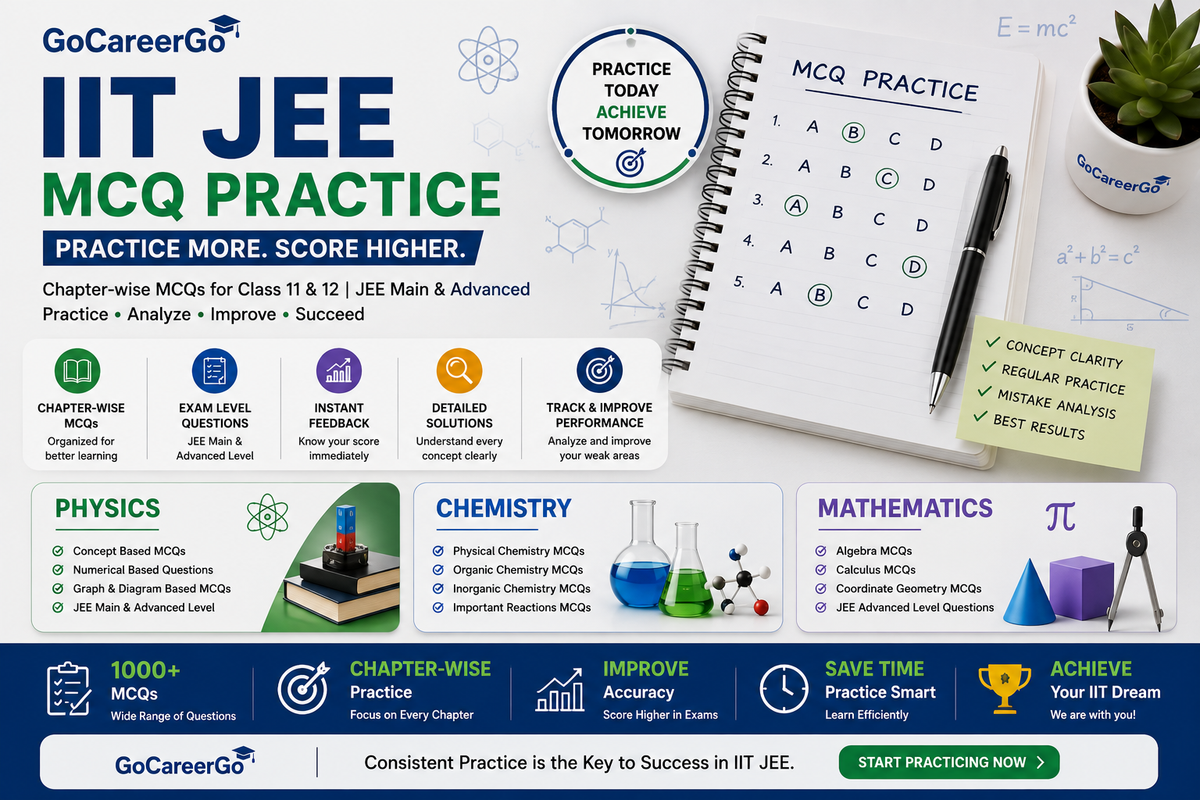
Regular MCQ practice helps improve speed, accuracy and confidence.
After completing a chapter, solve questions related to that chapter rather than immediately jumping to random questions.
Recommended Practice Flow
Basic Questions
↓
Chapter-wise MCQs
↓
JEE Main Level Questions
↓
JEE Advanced Level Questions
↓
Mixed Practice
↓
Mock Test
After every practice session, analyse your mistakes.
Ask yourself:
- Did I misunderstand the concept?
- Did I forget a formula?
- Did I make a calculation mistake?
- Did I misunderstand the question?
- Did I take too much time?
- Could I have solved it using a better method?
Chapter-wise IIT JEE Preparation
Chapter-wise preparation makes it easier to track progress.
For every chapter, try to complete these steps:
Step 1 – Learn
Understand the concepts and theory.
Step 2 – Make Notes
Write down important concepts and formulas.
Step 3 – Practise
Solve basic and intermediate questions.
Step 4 – Attempt MCQs
Test your understanding through objective questions.
Step 5 – Analyse Mistakes
Write down questions or concepts where you made mistakes.
Step 6 – Revise
Return to the chapter after a few days and revise it again.
JEE Study Plan
A good study plan should be realistic and consistent.
Instead of studying for very long hours for a few days and then losing consistency, create a routine that you can follow every day.
Daily Study Structure
Concept Learning
Spend time understanding new topics.
Question Practice
Solve questions based on the concepts you studied.
Revision
Revise formulas, notes and previously studied chapters.
Mistake Analysis
Review incorrect questions and identify weak areas.
30-Day JEE Revision Strategy
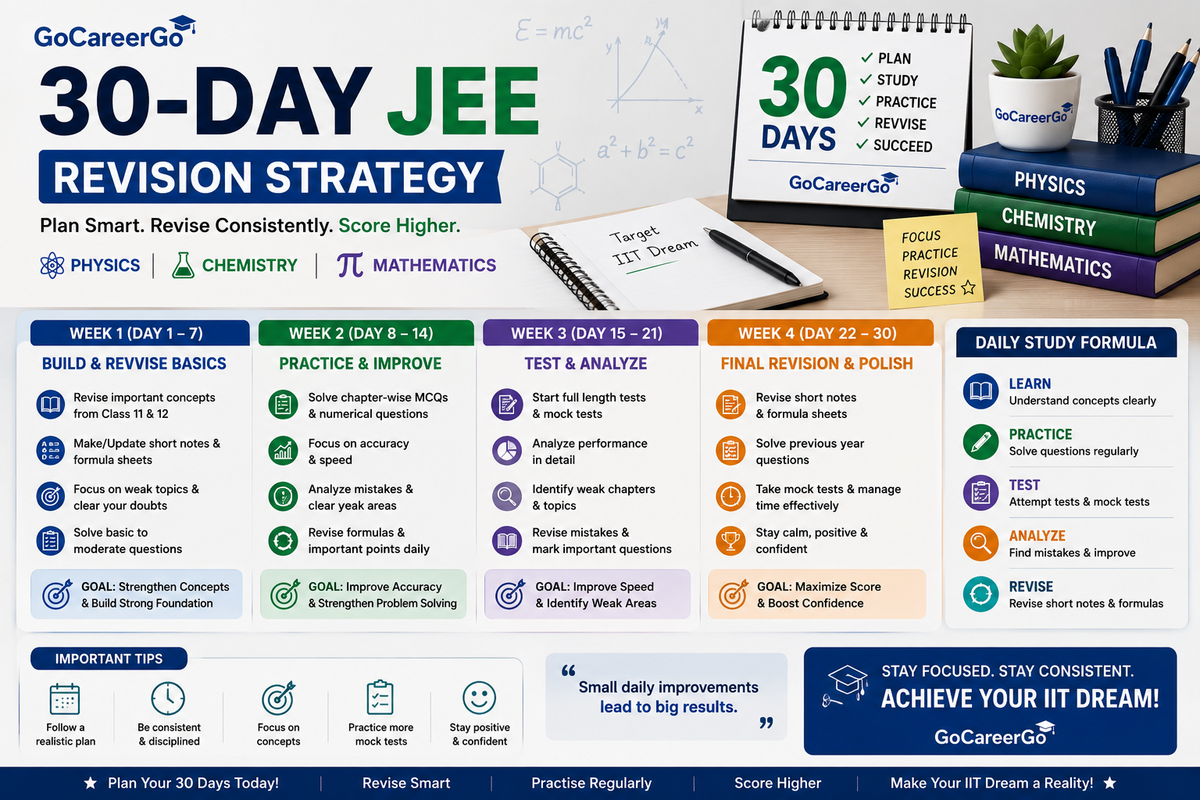
For students who need a focused revision schedule, divide your preparation into four stages.
Week 1
Revise important concepts and formulas.
Focus on chapters where your basics are weak.
Week 2
Increase MCQ and numerical practice.
Solve chapter-wise questions and analyse mistakes.
Week 3
Start mixed-topic practice and timed tests.
Try to improve speed without sacrificing accuracy.
Week 4
Focus on revision, mock tests and mistake correction.
Avoid spending too much time learning completely new topics at the last moment.
How to Use GoCareerGo for IIT JEE Preparation

GoCareerGo brings different preparation resources together so students can study and practise from one place.
You can use the resources in this order:
1. Select Your Class
Choose Class 11 or Class 12 based on your current preparation level.
2. Select Your Subject
Choose:
- Physics
- Chemistry
- Mathematics
3. Study the Chapter
Start with the chapter-wise study material and understand the concepts.
4. Revise with Short Notes
Use short notes and formula sheets for quick revision.
5. Practise MCQs
Test yourself with chapter-wise questions.
6. Review Your Mistakes
Identify the concepts that need more practice.
7. Repeat and Improve
Keep revising and practising until the topic becomes comfortable.
Important JEE Preparation Resources
Use different resources according to your preparation needs.
📚 Study Material
For understanding concepts and building a strong foundation.
📝 Short Notes
For quick revision.
📐 Formula Sheets
For remembering important formulas and relationships.
✅ MCQs
For testing your understanding.
🧠 Important Questions
For focused practice.
🖼️ Diagrams and Images
For visual learning and quick revision.
📊 Practice Tests
For improving speed, accuracy and exam readiness.
Common Mistakes Students Make During JEE Preparation
Avoid these common mistakes:
Studying Without a Plan
Random preparation can make it difficult to track your progress.
Only Watching Lectures
Understanding a concept is important, but solving questions is equally important.
Ignoring Revision
Without revision, previously learned concepts can become difficult to remember.
Avoiding Difficult Questions
Difficult questions can help identify areas where your understanding needs improvement.
Not Analysing Mistakes
Simply checking the correct answer is not enough. Understand why your answer was incorrect.
Collecting Too Many Resources
Too many books, notes and resources can create confusion. Choose useful material and complete it properly.
How to Improve Your JEE Preparation
Follow a simple cycle:
Learn → Practise → Test → Analyse → Revise
Do this consistently for Physics, Chemistry and Mathematics.
Your goal should not be to complete the maximum number of chapters in the shortest time. Your goal should be to understand the concepts properly and improve your ability to solve questions.
JEE Main Preparation
JEE Main preparation should include strong conceptual understanding, regular MCQ practice, chapter-wise revision and timed tests.
Focus on:
- Syllabus coverage
- NCERT-based understanding where relevant
- Formula revision
- Chapter-wise questions
- Previous-year questions
- Mock tests
- Time management
- Accuracy
Always check the latest official examination information, syllabus and instructions from the relevant official examination authorities.
JEE Advanced Preparation
Students targeting JEE Advanced should gradually move towards higher-level problem solving.
Focus on:
- Strong fundamentals
- Multi-concept problems
- Analytical thinking
- Advanced-level questions
- Previous-year questions
- Time management
- Detailed mistake analysis
Do not jump directly into difficult problems without developing the fundamentals first.
JEE Previous Year Questions
Previous-year questions are valuable because they help students understand the type and level of questions asked in the examination.
When solving previous-year questions:
- Attempt the question without looking at the solution.
- Give yourself a reasonable time limit.
- Check the answer.
- Understand the solution.
- Mark difficult questions.
- Revisit those questions during revision.
JEE Mock Test Strategy
Mock tests should be treated as an opportunity to understand your preparation.
After each mock test, analyse:
- Total score
- Correct answers
- Incorrect answers
- Unattempted questions
- Time spent
- Weak chapters
- Repeated mistakes
The purpose of a mock test is not only to get a score. It is to discover what you need to improve.
Build a Strong Revision System
A simple revision system can make your preparation more effective.
First Revision
Revise soon after completing the chapter.
Second Revision
Revise after practising questions.
Third Revision
Revise before a test.
Final Revision
Use short notes and formula sheets for quick revision.
Frequently Asked Questions
When should I start IIT JEE preparation?
Starting early gives you more time to understand concepts, practise questions and revise. Class 11 is a good stage to begin systematic preparation.
Can Class 12 students start JEE preparation?
Yes. Class 12 students can still create a structured plan, prioritise important concepts, practise questions and revise consistently.
Should I study Physics, Chemistry and Mathematics every day?
A balanced routine is generally useful, but the exact schedule should depend on your strengths, weaknesses and available study time.
Are short notes useful for JEE?
Yes. Short notes can make revision faster by keeping important formulas, concepts, reactions and shortcuts in one place.
How important is MCQ practice?
Regular question practice is essential because it helps you apply concepts, improve speed and identify weak areas.
Should I focus only on difficult questions?
No. Build your preparation progressively. Start with fundamental questions and gradually move towards higher-level problems.
How should I revise before an exam?
Use short notes, formula sheets, important questions, previous-year questions and mock-test analysis instead of trying to relearn everything from the beginning.
Start Your IIT JEE Preparation Today
IIT JEE preparation is a long-term process. You do not need to master everything in one day.
Start with one chapter, understand the concepts, practise questions, revise your mistakes and continue improving.
Study Smart. Practise Regularly. Revise Consistently.
Use GoCareerGo to explore IIT JEE study material, short notes, formula sheets, MCQs, important questions and preparation resources for Class 11 and Class 12.